
Ayyub´s Vermicompost Livelihood
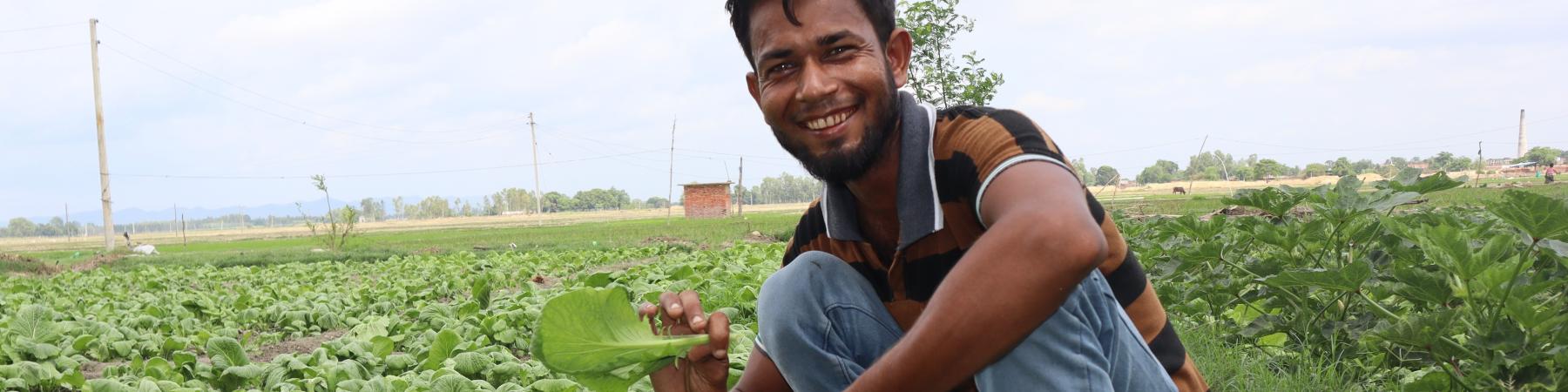
“When Ayub fi rst started making vermicompost, people mocked at him. But now, seeing him making profi ts from the business, and the positive impact of his organic farming practice on the environment, we get inspired. He has become a role model for young entrepreneurs in the community.” Juber, Ayub’s neighbour
Ayyub, a 24-year-old resident of Nepalgunj SubMetropolitan City, Nepal, grew up in a community predominantly inhabited by Muslim and Madhesi families. Like most Muslim children in his area, Ayyub initially attended a madrasa before transitioning to a local school. However, financial difficulties forced him to drop out in grade six.
“After quitting school, I assisted my father with farm work. Later, I even thought about going abroad for work,” Ayyub recalls.
Ayyub’s family relies on vegetable farming managed by his father, Umar. The household includes seven members including his wife, daughter, parents and two brothers. Despite his efforts in farming and later as a gardener, Ayyub struggled to earn enough to support his family. It was at this pivotal moment that Ayyub connected with the POWER4AY project. Through the initiative, he participated in various training programs, including a five-day micro-entrepreneurship development course, a life skills course, and a comprehensive 390-hour training on vermicompost and nursery management. These opportunities marked a turning point in Ayyub’s life.
“In the presence of project staff, my parents were oriented about the project’s objectives. I applied for the training at the ward office, and eventually, five young people, including myself, were selected. We were encouraged to produce vermicompost fertilizer and visited the Everest Organic Farm in Karakando Chowk. Seeing its potential as a good source of income and its benefits for vegetable farming, I decided to use this fertilizer for growing organic vegetables,” Ayyub explains.
Equipped with new skills and knowledge, Ayyub launched his own vermicompost and flower gardening business, abandoning his plans to work abroad.
“While running the business, I faced challenges in accounting. The project helped by involving me in fi nancial literacy and numeracy sessions where I learned bookkeeping and math skills. I also received two days of green mentality training, which taught me to run my business in an environmentally sustainable way. Now, every day, I wake up at 6 a.m. and work as a gardener in three houses in Nepalgunj, earning NPR 9,000 per month. Additionally, I earn around NPR 19,000 per month by selling fertilizer. The project staff continues to advise me on business management,” Ayyub shares.
Ayyub’s transition from chemicals to using his own vermicompost fertilizer has not only made his farming more sustainable but also improved the profitability of his business. Today, he contributes significantly to his family’s household expenses and supports his siblings’ education and nutritional needs.