
A Pad Factory is Rewriting the Norms in Dailekh, Nepal
Before this, most of us relied on family members for financial support,” says Bimala. “Now, we are earning, managing a business, and making decisions that shape our future. With the money we make, we are also sending our children to school.”
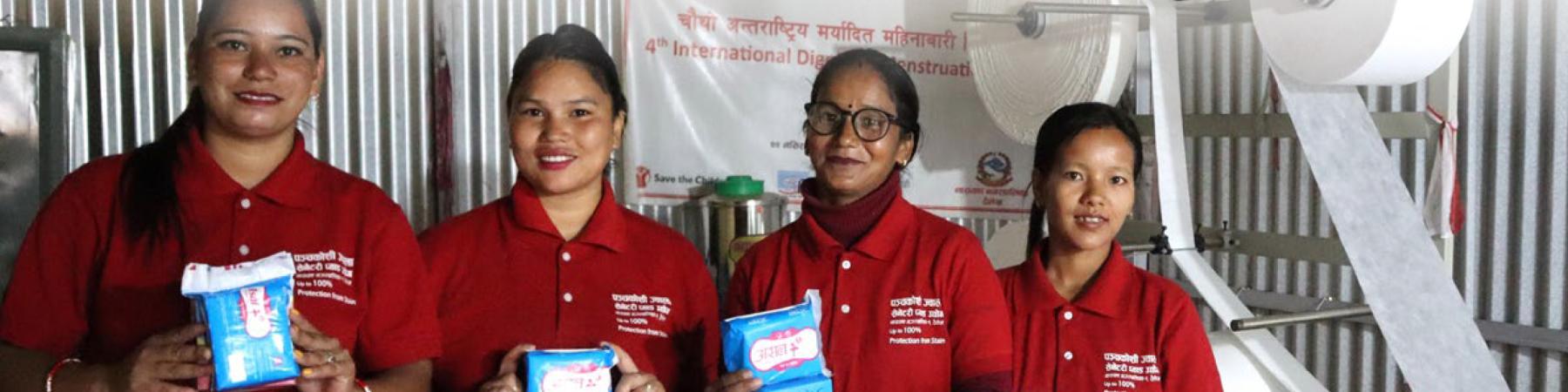
In the heart of Dailekh, where patriarchy and traditional gendered mindsets dictate livelihood choices, a small factory run by a group of young women is defying all odds and breaking the glass ceiling—head-on! Welcome to Panchakoshi Jwala Sanitary Pad Factory, which is more than just a factory— it’s an incubation hub that empowers young women entrepreneurs, instills leadership skills, and creates employment opportunities for women and girls who are often confined within the four walls of their homes, or restricted by gender norms.
Run by four entrepreneurs—Jagati, Bimala, Laxmi, and Dipa—the pad factory is not just a workplace; it has become a symbol of independence and empowerment.
“Imagine breaking free from the stereotype that girls can’t do business—and proving society wrong. That’s what empowerment feels like,” says Jagati, 28.
The entrepreneurs were first introduced to Save the Children’s ‘Pathways to Wellbeing, Empowerment, and Resilience for Adolescents and Youth (POWER 4 AY) ‘, implemented by Everest Club in Dailekh, where they participated in a Micro enterprise development training program.
“During the training, we learned about business models, market research, coordination, and basic financing, and we were encouraged to propose a business plan. That’s when we came up with the idea of a pad-making company—because menstrual hygiene is essential, and sanitary pads are a basic necessity,” shares Jagati.
She further explains that their business is not just about selling pads—it carries a mission to normalize menstruation and ensure that girls and women have access to affordable, locally produced sanitary pads.
The factory produces both disposable and reusable cloth pads, with the latter gaining popularity as a sustainable alternative in rural areas. By adapting packaging sizes and securing contracts with local schools, they have made their products more accessible. So far, their efforts have generated an impressive income of NPR 2,172,603, proving that youth-led enterprises can thrive even in rural settings.
“Through our work, we are sustaining ourselves, creating job opportunities, and, most importantly, rewriting the norms that undermine a woman’s worth—we are proving them all wrong!” says Bimala, smiling.